


Matt865
-
Posts
307 -
Joined
-
Last visited
Everything posted by Matt865
-
OVP relay?
-
You're giving me the incorrect idea with those prices. I'd want to see high-mileage vehicles that have sold for £24k in the last year, but I haven't seen any. I've looked on AutoTrader, and some are selling for less than that, while others are selling for £17k. The pricing of these cars may vary greatly based on factors like condition, mileage, and accessories.My vehicle, which had 21,00 miles when I bought it two years ago, cost £25,500.So, that's a 2019 plate for our purposes here. It's a stolen and recovered cat n mite. When I was in the market for a vehicle, I saw similar ones for between £30,000 and £31,000, with similar specs.Vehicle had just one owner and was not a cat, too.My car is currently worth around £20,000 in its stock condition. However, I did spend around $2,000 on an engine 4 pin crank hub upgrade, which is likely the only modification that will return your investment. I believe you could get a better price if you sold all of the parts it has. Just so you know, even though you claim it's a M Performance Bonnet, it's not a BMW M Performance Bonnet because they didn't equip it with carbon fibre and other premium materials.
-
Hello I am not aware of any, and I too find this bothersome. I observe my Apple CarPlay, since it serves as my default display and indicates the time. I find it peculiar, to be honest, that there are several superfluous choices and no option for a clock.
-
Contact your breakdown service provider.
-
MOT failure due to a damaged coil spring on the Mercedes W211.
Matt865 replied to DreamWeaver's topic in General Discussions
Visit the Sachs website; they will likely direct you to the appropriate springs. Given the quantity, eBay vendors can likely deliver them to you within a few days. What are the seals to which you refer? -
Greetings, I apologise for the little information. The vehicle is a 2008 BMW 320d, displaying warning lights on the dashboard, lacking parking sensors, and indicating a DPF engine management issue with a message of lower power; yet, it operates OK. It does not have satellite navigation. The vehicle operates OK; nevertheless, warning lights activate intermittently, and it sometimes stalls. I own a diagnostic reader, although no errors are detected. I have performed a DPF regeneration, but it continues to malfunction.
-
Greetings, everyone. My BMW is exhibiting peculiar behaviour, such as random dashboard lights activating without any stalls. Could this be related to the head unit, if that is the correct term?
-
Clunking sounds while shifting to reverse
Matt865 replied to TechWhiz's topic in General Discussions
The only issue is that I am now midway through the replacement process (the old rusted subframe has been removed, and the new is partially constructed) and BlackC55 (the Mercedes dealer) has told me that without a comprehensive corrosion inspection history documented in the service book, Mercedes would not consider the matter at all. I believe the subframe problem ought to have been classified as a recall item; but, consider the financial implications for the ostensibly kindly Mercedes that we are familiar with. I will publish some text and images once completion. -
Clunking sounds while shifting to reverse
Matt865 replied to TechWhiz's topic in General Discussions
Hello everyone, may I provide a few ideas? Indeed, the 'parking pawl' is a mechanism that secures the gears from rotation. Many people depend on this mechanism to secure the vehicle while parked on an incline; nevertheless, it was not designed to support the weight of the automobile and may sometimes fail. The proper approach on an incline is to engage the foot brake, activate the parking brake, shift to neutral, release the foot brake to allow the parking brake assembly to take up slack, and then shift to park. Vehicle immobilised with no stress on the parking pawl/pin. It is OK to use Park mode while on a level surface. A 'thump' while shifting gears may indicate that the rubber couplings in the prop shaft have stiffened over time. Replacing these components may resolve the issue; however, it is neither a cost-effective nor straightforward solution, since each unit costs around £40 to £50, and considerable disassembly of the underbelly is necessary for removal and replacement. I will replace these components on my vehicle as part of the rear subframe and suspension arms refurbishment job I am now doing. -
As a newcomer to BMW, how can I perform updates?
Matt865 replied to Paulinelinker's topic in General Discussions
formerly priced at £99 for any updates, regardless of warranty status or recall work. -
It is not just concerned with the worth of the alterations. The insurance company may categorise an individual who has made certain modifications as a 'boy racer' and hence a greater risk, which I am convinced the original poster is not.
-
The configuration was same on the VW T4 Transporter; the driver's side was 'landscape', while the nearside was 'portrait'.
-
A superior option involves cutting a piece of metal from a discarded beverage or soup can to use as a shim for the battery post. Adjust the strip's width to match the height of the battery post. Adjust the length to accommodate the space required between the post and the terminal.
-
The battery terminals are conical. Ensure that the terminal is positioned at the widest section of the post; otherwise, it will not achieve complete tightness. Occasionally, it is necessary to loosen the terminal nut and slightly open the terminal to enable it to descend completely down the post.
-
This implies that all front sensors are nonfunctional, indicating a potential malfunction in the connection to the control unit, potentially a damaged cable. The reason for the bumper replacement is not specified, although it is likely due to a frontal collision, suggesting that damage may be concealed and not limited to the bumper itself.
-
A fractured nozzle holder cap may result in leakage at the injector foot, perhaps leading to subsequent black death. Rear wells are inferior due to the drain line's positioning towards the rear of the engine, which I suspect is somewhat slanted.
-
OTA updates fails so much on last time
-
I would not engage in such endeavour. Oil has a far longer lifespan than 30,000 miles, therefore £560 is too high. Conserve your finances; the issue lies not with the oil. I operated a 530d equipped with a six-speed automatic gearbox. Sytners conducted a recall, disconnected the battery cable for many hours, and upon retrieval, the vehicle operated much better. As previously said, just drive it for over 500 miles, and unless it is severely damaged, the gearbox will self-correct.
-
The adaptive main beam has ceased functioning.
Matt865 replied to Screwdriver_1's topic in General Discussions
Same problem on e-class -
thanks for the link
-
50% chance excluding the possibility of the coin falling on its edge
-
If it is at 0V, I believe you are expending your efforts in vain. The battery will not recuperate. While it may ultimately display a reading of 12V, its functionality will be compromised, resulting in little capacity.
-
What are your thoughts on this? - Inexpensive W204 Estate
Matt865 replied to AMG33D's topic in General Discussions
Appears to be a genuine detriment. Adore it 😀 -
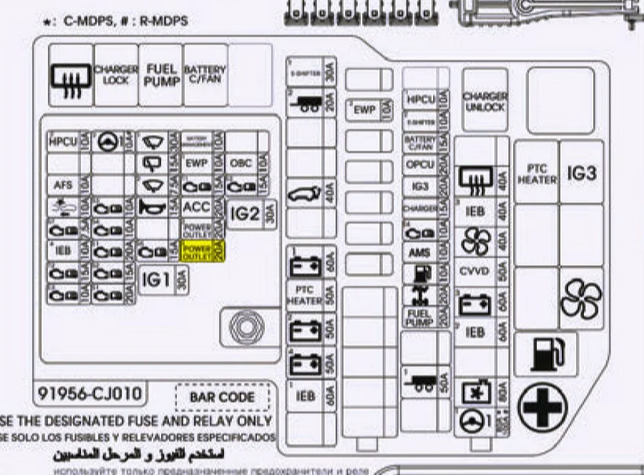
As stated in pages 8-44 to 8-47 of the handbook, the fuse responsible for the baggage power outlet is labelled "Power Outlet 1" and can be found in the fuse box located in the engine compartment. It is marked in yellow for easy identification. Power Outlet 2 is located next to it and serves as the front power outlet. Both fuses have a rating of 20 amperes.

-
Does anybody have any ideas?